Tina Clancy’s lifelong love for sketching and drawing unexpectedly took a back seat to a new love seven years ago when she registered for a six week painting class with her sister. Prior to this class Tina had never painted before. In this interview Tina shares with us the beginnings of her newfound calling and the steps she has taken to establish herself as a serious artist whose work continues to evolve with each new painting she creates.
Sherry: Why did you start painting?
Tina: One summer, my sister suggested that we take a 6-week painting course together. She thought it would be a fun way for us to spend time together once a week. The course was a freestyle painting course, most of which was done outdoors when the weather permitted.
Although I had spent most of my life drawing and sketching, I had never painted before and I didn’t believe it was for me. To my surprise I quickly adapted to this style of painting…I became hooked on the liberating feeling of “drawing” in such a loose manner.
Following the completion of the course, the class as a whole wanted to continue to paint together. One fellow classmate offered to show us a method she had learned at a workshop. We rented space in an art school and there we learned how to create abstracts on paper with flowing acrylic washes and fluid acrylics. Again, I was hooked.
In six short weeks I learned the possibilities are endless when paint meets surface. It was this vast realm of possibility at my fingertips that made me decide to put down my sketchbook and pick up painting for good.
Sherry: Do you paint on a daily basis?
Tina: I used to paint more or less every day, for the first 3 years. Painting every day in my early years was critically important, especially because I was still trying to figure out the materials: preparing canvases, painting with palette knife, the effect of polymer on my paintings, and loads more. Everything was new, and required lots of practice. Plus, I was in such an experimental stage and I didn’t want to deny myself this playful phase. I loved trying new techniques, especially working with dilutions and other water effects, or texturizing surfaces, or dabbling in mixed media. It seemed there was nothing I didn’t want to try, and painting became my life.
Nowadays, if I get into the studio to paint every few days, that is quite sufficient for me. While I would love to get into the studio every day, other things in life come up, and I am a very different type of painter now than I was when I first started.
Sherry: Would you care to elaborate on that? How are you a different painter today?
Tina: Currently, I have many paintings on the go, at various stages, and I may only be able to add a little bit to them each time I am in the studio. I no longer worry that time spent away from the studio will have a detrimental effect on my work. I now have the experience and the confidence to know that the paintings will get done when they get done, whether I am painting every day or not.
Sherry: Although all of the works showcased on your website are worthy of discussion there are three works in particular I am curious about. The paintings in question are: Eastertide, Vintage Cheer, and Staying the Course.
Staying the Course is somewhat abstract but also impressionistic? Vintage Cheer I see as impressionistic. And, Eastertide is abstract? Am I reading them right?
Tina: Yes!
Sherry: These three paintings have similar colour schemes yet they are quite different from each other with regard to subject matter. I am interested in how they came to be. Can you tell us about your thought process when you were creating these paintings?
Tina: Perhaps it would be best to discuss them individually because each painting reflects my love for exploring new techniques. They are also a testament to my commitment to challenge myself to master these new techniques so my work evolves and I mature as an artist. I will start with Eastertide, the earliest work of the three pieces.
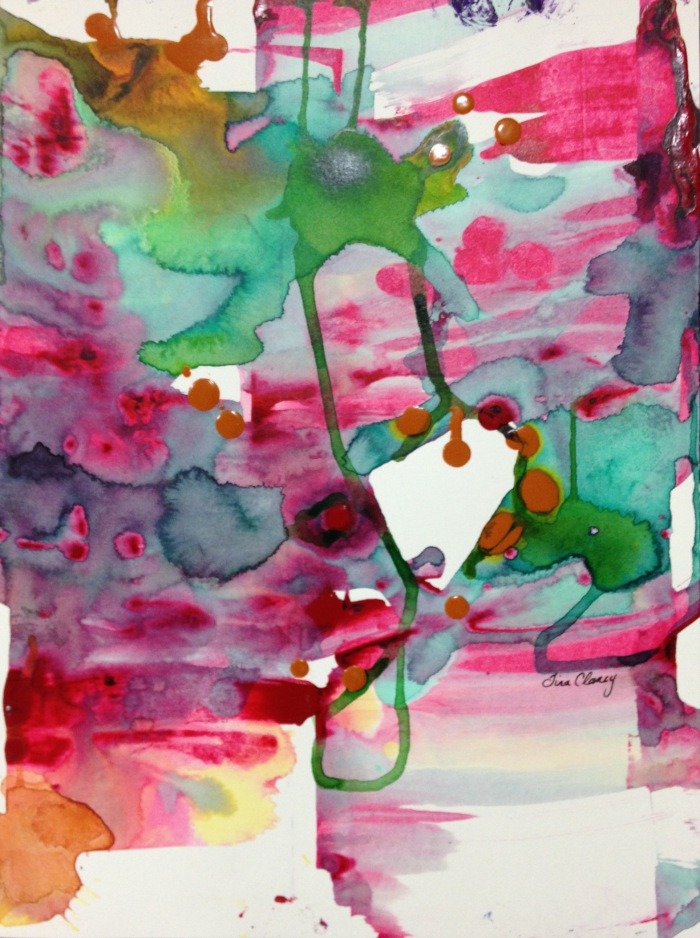
Tina: Eastertide was created using an acrylic “pour painting” method. Simply put, water is used to dilute acrylic paints ever so slightly to get them to spread freely and interact at different rates on wet paper.
Pour painting is spontaneous and quite dynamic. I love the effects I can get by simply adding a new colour or by tilting the paper or by sponging paint off the surface. Plus, the myriad of colours available in acrylic paint allow me to have incredibly bold and bright, almost gemlike colours in my paintings.
I called this piece Eastertide because it seems to have the yummy colours of Easter egg candy. It also reminds me of the promise of spring as we prepare for Easter.
Sherry: Unlike Eastertide and Staying the Course, Vintage Cheer is representational. What was your inspiration for Vintage Cheer?
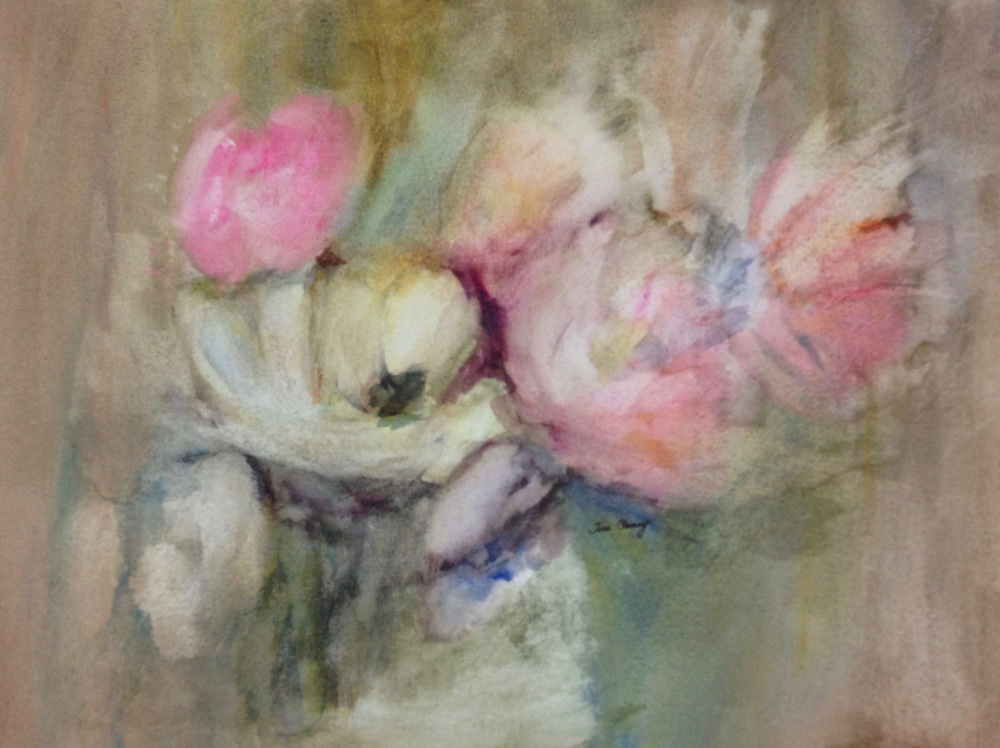
Tina: I painted Vintage Cheer soon after I took a watercolour course in July 2015. I was so impressed by the instructor, Fabio Cembranelli, a renowned painter from Brazil, that I desperately wanted to paint watercolour florals like he did. However, after I painted Vintage Cheer and only a couple others, I realized it would require years of dedication to master his technique, and at the time I was still trying to establish myself with acrylic painting. So I left watercolours and, with the exception of a short course I took last year, I have not returned to them. It is in part because watercolour painting for me is almost by definition “planned,” and I prefer to paint intuitively. Vintage Cheer was all planned.

Tina: Staying the Course is the very first painting in a series called Sea and Sky. My main objective in this series was to keep the horizons relatively low, and at times obscured. For this reason, Big Sky was the original name for this series.
Over time and with each new painting (I have 17 in the series, with at least 4 more on deck) the sea factored in as much as the sky, and more so when the weather was stormy and the sea was rough. To call these paintings Big Sky didn’t make sense so much anymore, so I renamed it Sea and Sky Series.
Even though at times a painting in this series emerges as a storm at sea, I find it utterly relaxing to paint in this style and therefore I keep going back to it when I find I need a break. I love the sweeping strokes I need to take for the smoothed out backgrounds or the rougher ones that cause stormy effects. More and more I have used a palette knife to add stark effects. As for whether this was planned or spontaneous – all of the paintings in this series are planned with regard to horizon and restricted palette. Otherwise, it is all spontaneous, or what I prefer to call, intuitive.
Sherry: I love these three paintings! And, I am wondering how you feel about them? Tina, are you happy with these paintings?
Tina: I am happy with all of them, but least happy with Vintage Cheer because it was meant to be in the style of my instructor – and in that regard it is a complete failure!
Sherry: Of the three do you have a favourite?
Tina: By far Staying the Course is my favourite, and might still be my favourite in the whole series. For me it has the perfect mix of clarity and mystery that I like in abstract impressions.
Sherry: Do you have a favourite painting style?
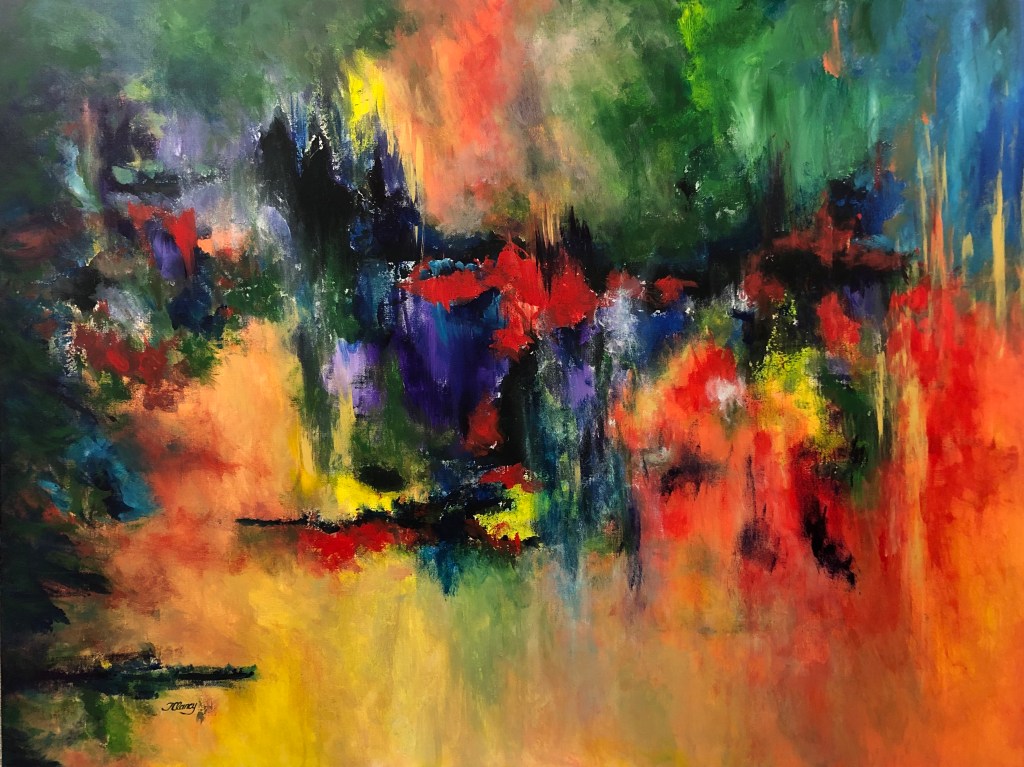
Tina: I have three: 1) complete, non-representational abstracts (as in A Night in Bordeaux) in which I can paint with broad, sweeping strokes, 2) blurry, misty, mysterious impressionistic abstracts, or abstract impressions, and 3) the method of pouring slightly diluted acrylics onto watercolour paper, which I have called Luminous Paper Painting. However, I still like to dabble and play with other approaches, just in case I find a new favourite!
Sherry: What direction do you see your painting going in the future?
Tina: Pretty much the same, but on a larger scale. Especially for my Sea and Sky paintings. I am determined to keep my work evolving and reflecting my overall approach to painting and creating: imagination and intuition in all colours and forms.
Sherry: Tina, it has been wonderful speaking with you. Thank you for taking the time to answer my questions! Where online or in person can we see more of your work?
Tina: https://tinaclancyart.wixsite.com/home
Tina’s next step is…”To continue her painting series, such as Sea and Sky and Moonlit Shores, onto larger canvases.”
 Creative Reign